a film by vadim perelman starring uma thurman, evan rachel wood and eva amurri (daughter of susan sarandon).

as if i needed another reason to not read the san francisco chronicle… we wasted a baby sitter (when i could have waited to see this film on an airplane) based on mick lasalle’s review calling it “something in another league - emotionally sophisticated, humane and worth talking about for hours.” well, perhaps worth blogging about for a few minutes…

wood and thurman play the same role, separated by fifteen years. wood is a slightly more convincing 18-year-old than thurman (gorgeous though she is) is a 33. the character they play, diana, is a spirited teenager and a frightened upper-middle-class wife/mother/community college art history teacher who is coming unglued in spite of a pinch-me-i-must-be-dreaming perfect life. through a series of countless flashbacks you learn that the middle-aged diana’s issues stem from a columbine-style encounter she and her best-friend-forever (amurri) had in the girls’ room with a teenager and his automatic weapon. the girls are told he will kill one of them and given the choice of which it should be. the rest of the flash-forward-and-back, i mean movie, is meant to illuminate the characters of and relationship between the girls-on-the-verge-of-becoming-women.

the camera work in the film is luscious. from the opening shots of out-of-focus, over-saturated, full-blown flora to swarming ants on the plumage of a rotting (though beautiful) bird in the grass, the poetic imagery is constant. there’s a fixation on decay. oh, and the water… languid scenes in a swimming pool, the back-lit spray from sprinklers, rain, bathtubs, more rain, fish tanks, “the human body is 70% water.” etc. the poetry and symbolism is too constant. diana is the stereo-type bad girl, her friend maureen the goody-goody. this is a film about guilt. and the water and blood (and self-sacrifice) required to wash it away.

ok, if you haven’t seen the movie but think you might, you should stop here, because i’m going to ruin it for you…

i can’t think of a film that jerks you around as much as this one does. you neither have to have been intimately connected to a mass murder, nor a parent to make lingering images of bloodied children scattered on the floor throughout a school unbearable. follow that with a child choking in a restaurant where no one knows how to heimlich, a sloppily performed abortion on a teenager, a dazed character walking in slow-motion into speeding traffic and two best friends, longing for their “lives to begin” forced at gunpoint to decide which should die.

of course, it has to be the “bad girl.” she has to be punished for her “sluttiness”/having the bad judgment to have unprotected sex with a tough/not telling anyone that yesterday the shooter had threatened to kill everyone at the school/having an abortion, right? too clean and too preachy. “the life” we’ve seen uma thurman acting out is the life that evan rachel wood imagines hers might have been as it passes “before her eyes” in the last moments of her life. it’s the trick ending that you immediately realize had been hinted at throughout the film.

the problem with the trick is that it’s not a new one. have you read ambrose bierce’s short story — written in 1890 — “an occurrence at owl creek bridge” (http://www.online-literature.com/bierce/175/)? or read nikos kazantzakis “last temptation of christ” or seen scorsese’s film of it? the film also owes a debt (for reasons i won’t disclose) to “the swimming pool” with charlotte rampling. now that is a film worth getting a babysitter for…

in the realm of mainstream hollywood this film is a 7. at the art house, a 5.

by lordy rodriguez.    video by david stroud.

this is a portrait of first lady pat nixon by andrea higgins.

several years ago, higgins became interested in representing people by painting textiles from their wardrobes. fabrics are fundamental to the aesthetics of a culture and for higgins, a style of dress can be as evocative as the representation of a face. first, she did a group of paintings — glen plaids, herringbones and tweeds — that her grandmother had worn. the paintings were abstract and optical and very familiar. for higgins, they represented “the look” of her grandmother and inspired memories of her. every fiber was represented by a brush stroke and each stroke was built up, one color upon another, layer over layer, to created a three-dimensional mark. in a sense, the images are woven of paint.

so actually, the first two images aren’t full portraits… they’re detail shots from paintings to give you a sense of the surface and labor inherent in this work and the relationship these paintings have to weaving. this is the full “portrait” titled “pat”:

and the dress pat wore to her daughter tricia’s wedding that inspired the portrait:

higgins’ “presidents’ wives” series was exhibited at the san francisco museum of modern art in 2003. since then, higgins has been working on portraits of characters from novels. in portraits of characters from books, she’s added another layer of abstraction and additional burden of labor to her paintings. because the characters exist first in the mind of the author, then that of the reader, there are no images from which to extrapolate. instead, she thoroughly researches the particular type of fabric from the specific era and society the character inhabited. the characters she portrays are particularly conscious of what they are wearing and what it says about them.

a close up of george babbit’ts brown suit, from sinclair lewis’ novel of the same name:

and the crettone in which george’s mistress upholstered her sofa:

the unfinished painting on the easel is a representation of the striped trousers worn by dorian gray.

a detail showing the bottom layer of paint - the horizontal bands of dark gray - as the lighter gray marks get worked across the surface. this panel will be 1/2 of a diptych representing dorian gray.

in the process of painting hundreds of thousands of marks representing threads in a piece of cloth, higgins began thinking about the objects that appear in traditional portraiture. since the inception of portraiture, people have both carefully selected the apparel they would be memorialized wearing, and the objects they surround themselves with. those objects represent the the pursuits and interests of the sitter as well as their social status and aspirations.

holbein’s “the ambassadors” 1533, in the collection of the national gallery, london.

higgins became interested in a passage in oscar wilde’s “the picture of dorian gray” in which dorian is handed “a pile of letters, on a small tray of old sevres china” by his valet. wilde knew that an “old” or “soft paste” piece of porcelain would evidence dorian’s sophistication, taste and financial wherewithal. higgins researched the hand-painted decoration on 18th-century porcelain, which inspired this panel:

which is the other 1/2 of the diptych portrait of dorian gray. when completed, the panel representing gray striped morning suit trousers (the unfinished painting on the easel) will hang next to it.


this is a second portrait of dorian gray - a single panel. in this detail you can see how higgins handles paint as if she is painting on china.

and from the 11th-century japanese autobiographical novel, “the confessions of lady nijo” higgins is

painting from the following passage:

The next day, when the high priestess was to arrive, oxen handlers, messengers, and imperial guards were dispatched by the dowager empress to meet her.

GoFukakusa took special pains with his costume. He wore a yellow informal robe lined in green, with a design of burnet flowers worked into it, over a light violet gown bearing gentian flower crests, His light violet trousers were lined in green, and everything was carefully scented

At dusk her arrival was announced. The doors on the south side of the main room had been opened and dark gray curtained screens set out with smaller curtain stands inside. Soon after Empress Omiya received her, a court lady came to tell us: ‘The former High Priestess has arrived. This is an out-of-the-way place and I’m afraid our hospitality is sadly lacking, so please come to visit with her.’ GoFukakusa went at once, and as usual I accompanied him, carrying his sword.

historical images of “gentian flower crests” and brocade which influence the patterns higgins will work into the green and violet painted panels are pinned to the studio wall.

and this passage:

About this time the Kamakura government revealed its official displeasure over the breach between the two retired emperors and suggested a conciliatory visit, with Kameyama calling upon GoFukakusa. This prompted an elaborate discussion as to whether Kameyama should view the gardens or watch a kick ball game. GoFukakusa turned to Lord Kanehira and asked, “How shall we entertain him? What would be appropriate?”
Sake might properly be served before matters are too far along,” he replied. “Then, in the middle of the kickball game, when he is resting, some persimmons in sake would be appropriate. It would be suitable for one of the court ladies to serve.”

“Which lady” GoFukakusa inquired.

“Lady Nijo is about the right age,” came the reply. “She would be a far from unfortunate choice.” And so I was assigned the task.

For the occasion i donned raw silk pleated trousers, a seven-layered gown in various shades of red, two outer garments — one crimson, one yellow lined in green — and a light green formal jacket. underneath i wore two sets of small-sleeved gowns: a three-layered set in red and pink shades of brocade and a two layered set in chinese brocade.

andrea higgins will have a solo exhibition at my new york gallery 3o october - 2o december 2oo8.

thomas nozkowski

April 26, 2008

i went to see the show “recent (made in the course of the last three years) paintings” at pace yesterday.

i’ve known his work for years and probably would have missed the show (it’s so easy to get wrapped up in your day-to-day) had andrea higgins not asked me to see it. it’s a relief to look at work by someone who’s been practicing for more than 30 years and remained true to a vision. and while i don’t have any personal knowledge about his market, the work is clearly well outside anything that has been en vogue for a long time, so i’d guess that his sales have been to a relatively small group of “connoisseurs.” in other words, for years he’s been making paintings to please himself, not a market. admirable.

a lot is being made of the “modest” scale of the paintings - about 22×30 inches. “could this mark a shift away from large abstract painting?!” people are always looking for trends. i guess it’s human nature. like when people look for recognizable imagery in clouds or need to see representation in abstraction. they need to find order to feel in control. not very interesting, but it fills space in newspapers and gives curators something to talk about and hang shows around. let’s put it this way, a lot of really good artists have been making work at this scale or smaller in the last 58 years. the scale of these paintings isn’t revolutionary.

there are a bunch of paintings in this show. more than 30, maybe 40. they are sensuous and intimate. he’s a man who understands his medium and knows how to make it do what he wants. at the same time you feel he delights in “happy accident” — there’s something organic going on in them. most appealingly, they feel like they have been painted with sincerity. even reverence.

all of that said, they don’t feel groundbreaking. they’re nostalgic — and not in a good way — they’re without freshness. they’re kind of abstract and kind of figurative and kind of symbolist and kind of about landscape. there’s a bit of late johns and a bit of miro and gustan and about twenty other people. and it doesn’t add up to anything that makes you think or feel any differently about anything…

so as much as i really wanted to love this work, particularly after andrea’s prodding, i just didn’t. it’s like richard tuttle for me. everything about it is what interests me - process, honesty of material, personal vision, serious artistic practice, trend-bucking, devotion to beauty, attention to craft, poetry, quirkiness - and yet i’m left unmoved. they failed to bewitch me.

which is the difficulty of work like this. when you make something shocking or flashy or spectacular, there’s no expectation for transcendence. the work is what it is - a one-liner. nozkowski’s reputation is that of a painters’ painter — an insider’s artist. with this show at pace, he’s being shamanized. these are mature, thoughtful paintings. they are, disappointingly, not magical.

“recent paintings” is up through 3 may 2008. all images are courtesy of pacewildenstein gallery. i reproduced the ones i like best, not a full range of the work and certainly not the ones i liked least.

medusa

April 22, 2008

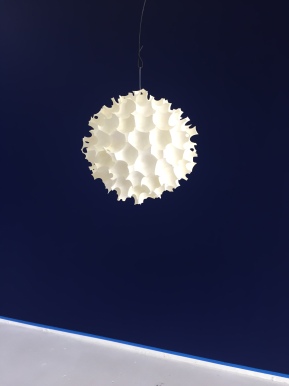
by timothy horn is based on 19th-century zoologist ernst haeckle’s illustrations of jellyfish. horn’s massive rubber chandelier refers to the history of ornamentation based on nature and the mythological gorgon. it is extraordinarily beautiful and at the same time monstrous… “medusa” which was recently exhibited at the andy warhol museum in pittsburgh will be exhibited at the san jose institute of contemporary art (www.sjica.org) from 15 august to 27 september.

the accuracy of haeckel’s illustrations are questioned by scientists but remain influential because of their beauty.

“medusa” (detail shot from underneath) 2006, silicone rubber, copper tubing, fiber optics, 72 x 102 inches in diameter.

sweet thing

April 19, 2008

“sweet thing” 2008, nickel-plated bronze and blown and mirrored glass, 60×44x9 inches

a new work by australian artist timothy horn, made for his upcoming project at san francisco’s herzog & de meuron designed de young museum. the exhibition, “bitter suite” will consist of three pieces inspired by the decorative arts collections of the san francisco fine arts museums and the life and legend surrounding the legion of honor’s founder, alma le normand de brettville spreckles, wife of sugar baron adloph spreckles.

horn’s work always begins with the history of design and aesthetics. from there it delves into social history, politics, mythology, sexuality and fetish. horn has written about this upcoming show:

i am intrigued by the stories that surrounded alma (which for me, were sparks that ignited ideas for the work I’ve gone on to make) - she was someone larger than life, the stuff that “myths” are made of - and therefore i’m sure, even during her day was the source of much swirling speculation, tall tales and chinese whispers, by both admirers and detractors.

i definitely share your affection for alma, whom you aptly, and I believe respectfully describe as a “monstre sacre”. . .

my precise interest is the intersection between beauty and grotesque, perfection versus vulgarity.

timothy horn’s exhibition “bitter suite” will be on view at the de young museum from june 14 – october 12, 2008

driss oudahi “fences” 2008 oil on canvas, 67×71 inches

“fences” (detail)

“signs of life” 2008 oil on canvas 70×87 inches

“guardian of the night” 2008 oil on canvas 70×87 inches


a recent review of oudahi’s work from the san francisco chronicle: http://www.hosfeltgallery.com/reviews/ouadahiSFChron07.jpg

“100 stories”

April 3, 2008

onehundredstoriesmed.jpg

a photograph by crystal liu from her exhibit that will open in new york on the 10th of april.

“i wanted to make this photo of wallpaper. before i moved into the room someone else lived there and made their own memories there. a house is a kind of storage space… just like someone’s journal. or brain. or heart. or a box of recipes.

the wall paper is about someone discovering something. so many questions are racing through my mind… i wonder who lived in this room? why beige stripes? it’s like when people go to the desert and dig for bones… it’s to piece together a more complete past. i want the whole answer…”

crystal liu, 2008

there is a hindu story of an elephant - restless, inquisitive, always straying… in india, elephants are sometimes taken through the narrow, fruit and vegetable stall-lined streets. the elephant with his restless trunk, will grab mango or coconut or bananas from the stalls as he passes. no punishment or coaxing can keep the elephant from wrecking havoc. but if the trainer gives the elephant a bamboo stick to hold in its trunk, the elephant will walk through the market with the stick, no longer stealing the produce because his trunk has something to hold on to.

the mind works in the same way.

michael light

March 26, 2008

some images from michael light to go with my comments on “the road” by cormack mccarthy (see “what i’ve been reading”)

_18-pinto-basin-at-500.jpg
michael light, “pinto basin at 500′” from “some dry space”

_15-cadiz-lake.jpg
michael light, “cadiz lake” from “some dry space”

_10-dragons-back.jpg
michael light “dragon’s back” from “some dry space”

_14-calumet-mountains.jpg
michael light, “calumet mountains” from “some dry space”

16-repro.jpg
michael light, “#16″ from “bingham mine / garfield stack”

07-repro.jpg
michael light, “#7″ from “bingham mine / garfield stack”

story telling

March 18, 2008

liuseasaythatuknowdet2_1.jpg

i’m working on a series of group exhibitions. the art will be paintings or drawings on paper. and narrative — not illustrative — the stories are original to the artists. the narratives are personal, intimate, and coded. the artists have developed personal visual vocabularies that allow them to express stories that are open-ended and can be interpreted in many ways, possibly posing more questions than giving answers. the work is lyrical.

shahzia sikander “plush blush 12″ (2003) gouache and ink on hand clay-coated paper, 15 x 11 1/2 inches

sikanderpb12.jpg

like all of the work that i’m interested in, these pieces are beautifully executed. the “craft” seduces you. next you’re bewildered by the story — the piece is purposeful — the message is puzzling. you can look and look and there’s always something new to discover. your interpretation of the work changes over the course of time. the imagery gets lodged deep in your psyche and repeatedly re-surfaces. as your life experience changes, so does your understanding of the art. that, in fact, defines what i think good art is.

chris ballantyne “untitled (stair)” (2007) acrylic on paper, 14 x 20 inches

untitledstair-20x14.jpg
crystal liu “nature’s betrayal (and i told her)” (2007) ink, watercolor, gouache and collage on paper, 21 x 21 inches

nbanditoldher-web.jpg

some of the work is obsessive. frequently i find work that’s a product of a focused, intense, often laborious process to be inward-looking, sincere and original. the key is that the work transcend navel-gazing and touch themes that are meaningful beyond a specific individual experience, culture or time.

rachell sumpter “the gleaners” 2007 gouache and pastel on paper, 11 1/2 x 18 inches

the-gleaners.jpg


why works on paper? the subject matter of this work is personal, and internal. works on paper often feel very intimate. as if (and it’s sometimes the case), the artist stopped in the middle of a thought or experience and recorded their emotional place on paper. the creative process seems less planned, less edited, more raw, spontaneous and honest.

yuka yamaguchi “park - debut” (2007) colored pencil on paper, 14×11 inches

04-park-debut800.jpg

the first exhibition in this series will open in new york the 10th of april. it’ll be called “100 stories” and focus on the work of crystal liu. we’ll show a group of her photographs, as well as a group of her ink, water color and collaged drawings.

crystal liu “the sea (say that you know)” 2008 gouache and ink and collage on paper, 27×27 inches

liuseasaythatuknow_1.jpg

at the same time, we’ll show a group of ruth marten’s drawings made on found 18th century engravings. rachell sumpter’s gouache and pastel drawings and yuka yamaguchi’s colored pencil drawings.

yuka yamaguchi “koinobore” (2007) colored pencil on paper, 14×11 inches

03-koinobore800.jpg

by showing works in series, the artists can play with themes and explore issues more fully. it also gives a viewer a better opportunity to “decipher” the work.

the second exhibition will be in san francisco in september of 2008. i’m interested in suggestions for that show. have you seen an artist’s work that fits? do you make work that does what i’m describing? let me know… i’m looking for suggestions.

crystal liu

March 13, 2008

thestorm.jpg

“the storm” 2008  c-print 30×30 inches, edition of 7.   from the upcoming  show “100 stories” opening 10 april in ny.

ko-an (‘ko,än) noun : a paradoxical anecdote or riddle used in Zen
Buddhism to demonstrate the inadequacy of logical reasoning and
provoke enlightenment. Origin: Japanese, “matter for public thought,”
from Chinese gongàn “official business.”

The meanings of Crystal Liu’s enigmatic photographs unfold quietly -
revealing, obscuring, gently teasing, delighting. Quotidian objects in
domestic interiors become landscapes. Patterned wallpaper is the
forest floor; a lace curtain the falling night; spilled jam on a white
tablecloth a violent crime scene. Liu’s imagery is at first playful, then
puzzling and ultimately provocative, as domestic narratives become
metaphors for intimate relationships and private joy and tragedy.

anoka faruqee

March 6, 2008

img_7723.jpg

anoka faruqee is an extraordinarily talented artist who lives and works in l.a. she’s a conceptual artist who makes these gorgeous paintings composed of fields of interlocking brush marks. the image above is a detail of this painting (freehand fade to gray green ground”):

fadegraygreeng.jpg

the “pixels” that make up the picture reference islamic tile work (faruqee is a second-generation bangladeshi) and digital technologies and are hand-painted. the “fade” or “shadow” that appears in the paintings is effected by mixing more than a hundred subtly shifting colors for each painting.

you can see the way it works in this detail of a painting called “freehand fade to exposed gray green”:

img_7719.jpg

note the brush strokes visible in the paintings. while the paint is exceedingly flat, there’s surface texture resulting from the gesture of the mark-making.

“Each painting represents an heroic labor of inconceivable
precision, yet their scale exposes the “hand” and inevitable
irregularity in human endeavor. They are mementos of the
human ambition to understand, control and represent
phenomena — and its futility.” (from our press release)

we currently have an exhibition of faruqee’s work at our new york gallery.

img_7670.jpg

at their most basic, these paintings are about the way light moves across a surface. seeing them bathed in daylight — which modulates throughout the day — is a phenomenological experience far more compelling than anything elliason achieves. and what a treat to see these paintings in a context where you can examine the variations between paintings. i keep finding myself standing in front of a painting and being lost within it. marveling at the ability to create something so complex and beautiful. as solid and detailed and carefully constructed as the paintings are up close, they dissolve into something atmospheric a few steps away…

img_7665.jpg

an earlier, more “op-y” painting in our conference room:

img_7728.jpg

dscn6690.jpg

the atrium of jean nouvel’s new reina sophia… and a view of the outside from the street… dscn6688.jpg

we checked out espacio minimo — the gallery that shows liliana porter in spain — a first-rate gallery and a beautiful space. liliana’s work has always seemed a bit of an anomaly in their program, which can be pretty aggressive and even grotesque. admittedly, liliana’s work is not with out its perversity… but as i looked at the goya of saturn devouring his young at the prado, the aesthetic of the gallery and it’s place in the history of spain and spanish art made sense to me… (doctor fourquet, 17, madrid - http://www.espaciominimo.com)

we had an excellent lunch with jose and luis at “samar kanda” in the estacion de atocha. the food was continentally-influenced and was fantastic. the room is slightly colonial and overlooks the beautiful “winter garden” of the train station. this is one of the very few restaurants in spain that isn’t over-lit. the central train station of madrid, where the the restaurant is located, was overhauled in 1992 by pritzker prize winner rafael moneo. the original glass and steel building was designed in the 1880’s by a spanish architect who allegedly had design advice from gustave eiffel.

luis and jose recommended a couple of restaurants and based on our experience at samar kandar, i trust their advice. make reservations. we tried to walk in and couldn’t get a table. “come prima” at calle echegara 7. “zerain” on pais vasco.

also, have churros y chocolate at “chocolatería san gines,” pasadizo de san gines, hours: 6p-7a m-sun.

& when you’re dying for something other than jamon - excellent indian food at “guru,” calle echegaray 21 @ c. del prado.

at one point tessa said, “wow, it’s so nice to be somewhere where the men wear real shoes.” they also wear red/orange trousers and can pull it off.dscn6706.jpg

shop for beautiful shoes (men and women) at “carmina shoemakers” - gran via 58, men’s clothes at “gallery” on calle jorge juan in barrio de salamanca, and women’s clothes at “ekseption” on calle velasquez.

dscn6702.jpg

the best thing about contemporary architecture outside of the u.s. is the way it gets integrated into the fabric of the historical city. the new herzog and de meuron designed caixa forum (http://obrasocial.lacaixa.es/centros/caixaforummadridedificio_es.html) in madrid is shoe-horned into a narrow site bordered by tiny streets and looks like the junky space craft from ‘alien’ landed on top.

an old pink brick warehouse-style building was cut off at the knees and seems to float off the ground. in itself, that would look startling, but add an enormous, rusting, perforated steel-clad hulk to the roof and you get crowds of curious viewers.

dscn6703.jpg

dscn6698.jpg

the texture of the old pink brick and the tracery of the rusty steel are beautiful against the planted wall of the building that fronts paseo del prado. we didn’t get inside (and i hate it when buildings look good from the outside but don’t function well inside) but as a sculptural form in the context of the city, this gets 5 stars from me…

paseo del prado, 36 madrid

dscn6694.jpg

ARCO (madrid)

February 22, 2008

dscn6450.jpg

ARCO is supposed to be the oldest art fair - this is the 27th year - and by far the most heavily attended - more than 2oo,ooo people over six days - of the big international art “trade shows”. there are 25o-ish galleries in 3 pavilions. the range of work is enormous and the quality of the fair and work displayed is really high. the most expensive piece was a 23,ooo,ooo (that’s euros - not dollars) francis bacon painting, but there are two entire sections of the fair that are dedicated to emerging artists. this is the second year we participated. this year we were invited to do a project with jim campbell in the “expanded box” (new media) section of the fair. we took two pieces and installed them in a completely black space. sorry, my photos don’t look like anything, so i’m not including them. i was really happy with the booth, and like this fair a lot, but the location of the “expanded box” section sucked.

the fair is a beating to work. it runs wednesday to monday from 12 a.m. to 9 p.m. a long time on your feet on concrete.

this gallery - paris 1900-2000 - has great material. mostly work on paper - collage, drawing, photography - but also painting. highlights included several hans bellmer pieces.

dscn6441.jpg

of course, a lot of the art there is

dscn6454.jpg

(like this painting)

and for god’s sake, what’s with julian opie?

dscn6451.jpg

ARCO has a series of educational programs and each year has a “guest country” (this year was brazil) ensuring you’ll see galleries and artists that you don’t see at every other fair. when you consider that it’s in madrid, it beats the hell out of art basel miami and all of its satellites…

a really nice fabric piece by louise bourgeois at carolina nitsch:

dscn6439.jpg

‘ode a la nieve’ - a bound fabric book - 25 ‘pages’, with embroideredy and appliqués, from an edition of 14. 250,000 - forgot to ask if that was dollars or euros… i would like to live with this (if i had an extra 250k) but am not sure i’d live with it on the wall. you lose the physicality of the piece and the pleasure of having it revealed to you one panel at a time…

truth of the matter is, the art world right now is one international event after another, where insiders meet and schmooze… madrid is a perfect venue.


italica

February 22, 2008

dscn6617.jpg

founded in 206 b.c. about 9 km from the present-day sevilla, italica is the remarkably well-preserved ruin of a roman city that had about 8,000 residents. most of what you’ll see was was laid out under the patronage of hadrian a couple of centuries later. it takes about 30 minutes on a bus from the station in sevilla to the end of the santiponce line. it was a drizzly day mid-week and we were the only ones there.

the amphitheater seated 25,ooo and was the 3rd largest in the roman empire. the restoration is really successful — enough for you to understand what was there — without disney-fying it.

dscn6630.jpg

standing in the arena or walking though the passages beneath the structure, it’s pretty easy to imagine what it was like with gladiators there…

dscn6634.jpg
and they had little feet…

dscn6650.jpg

helen took this one…
dscn6639.jpg

a beautiful stone drain:

dscn6633.jpg

there are amazingly intact mosaic floors at the site.

dscn6614.jpg

dscn6616.jpg
the river shifted sometime in the 3rd century (probably silting up due to deforestation), leaving the city cut-off and abandoned. the town of santiponce was built on the oldest - pre-roman part of italica, but most of it remained uncovered by later buildings. excavations began in 1781 and continue. the entire site will never be uncovered.

chris ballantyne show

February 14, 2008

10.jpg

102.jpg

this is our first show with chris. we’ve been watching his work for several years and are really excited about it. it has the high level of craft that’s common to the work we show — refined and formal yet intuitive — personal and quirky but oddly universal. the show is two paintings on panel (the grain of the panel shows though the acrylic stain), several small paintings on paper, two large (60×80 inches) paintings on paper and a large painting made on the long wall of the biggest gallery space. chris painted on the wall over the weekend. we’d expected a couple of small areas painted on the wall, but came in to find that chris was more ambitious… i guess i’m mellowing. it looks great.

untitneighborhoodtight-knit_1.jpg
SFMoMA is getting this one.

galatea

February 7, 2008

galatea47x28x9.jpg
by timothy horn (200 8) nickel-plated bronze & blown and mirrored glass 47×28x9 inches

olafur eliasson

February 3, 2008

Alaina Says:
February 2, 2008 at 7:35 pm e
I want to know why you don’t like Olafur Eliasson.
I really liked his yellow room at the SFMOMA show.

ok, so it’s only my second page, or post or whatever it is, and i think i’m cheating already… i took alaina’s comment and instead of just writing a comment back, i had to start off on a tangent…

first, i actually really liked two of the pieces at the sfmoma show.

and when i said i don’t like olafur eliasson - i didn’t mean him personally - i’ve never met him (though i will admit now that when i personally don’t like an artist, it’s often difficult for me to like their art. and looking at an artist’s work, i often jump to some conclusions about their personality - more on that - if anyone wants to go there - on some future post).

my issue with o.e.’s work and the show at sfmoma is that people have latched on to the reputation of his work, and that is really what the show is about…

the work is supposed to be phenomenological. in fact, i’d say it’s more sensational… in my opinion the former is universal and fundamental. the latter is, (boy, now it’s getting ugly) candy.

what’s good phenomenological work? the best work by fred sandback, mark rothko or barnett newman.     or walter de maria’s “lightening field”  (http://www.lightningfield.org) –  the perfect foil to the eliasson show…     first, the lightening field isn’t about lightning (sorry, but you just have to take my word for that, unless you visit it yourself).    there is a sensuous aspect to the lightening field.   because you’re required to stay 24 hours if you visit, you watch the stainless steel rods change color with the light - from gray to blue to silver to blush to rosy pink and on and on, all against the bleak landscape.   the next level  to the piece  is fwhen you cross the line made by the outer-most poles, you immediately recognize that you are “inside”.   then and only then do you understand that up until that moment, you were “outside.”   what the piece does is make you feel the space you occupy in a way you have never understood it before.    more impressive to me is that as you move within the grid your sense of personal importance is reduced to something like the black fly clinging to your leg.

o.e.’s work is too tricky. smoke and mirrors. like a fun house.   i’d enter a piece, quickly flash on “oh, this is what i’m supposed to experience,” then start looking around to figure out how the piece was accomplished. then, i’d start spinning on what kind of resources it took to do it and how bloody much it must have cost sfmoma to put on this show…

if you don’t think along those lines, the show is probably really fun. carnivalesque undermines the level of craft and thought - but this show belongs at the exploratorium.

a piece like ned kahn’s at the airport is far more interesting to me… ned makes the invisible visible.   that piece is a catalyst for connecting you to your environment.

back to o.e.  –   in the yellow room, you walk in and everything/one in it seems  black and white. not the velvety black and white of cinema, but just icky black and white. louis (he liked the piece too) described it as being like moonlight, except that instead of there not being enough light to register color, in this case the light is bright and unforgiving and yet there’s still no color. it’s a sensation, but not much else. it’s a novelty - like a 3-d movie.

i do like the ironic take on museum gift shops that is the room of maquettes…

i also like the fan.   it feels dangerous.   sometimes art should be threatening…

hello

February 2, 2008

my friend phil convinced me that i should have a blog. or sort of convinced me. so i’m going to try…

i have contemporary international art galleries in san francisco and new york. website: hosfeltgallery.com. i show a range of painting, drawing, photography, technology and sculpture, but there’s definitely an aesthetic. i like work on paper because you feel like you’re close to the artist’s practice. i like paint. i’m less often convinced by sculpture, but when it’s good, it’s great. i like process. i’m interested in work that unfolds over time. maybe you’re immediately attracted, but there has to be something there that makes you keep wanting to look. i don’t generally like the kind of work that’s made for biennials. i don’t like olafur eliasson…

fso i thought i’d write about the art i’m seeing in exhibitions and studios. maybe about what i’m thinking about when i curate a show. conversations i have with artists and curators and such. what i like or don’t and why. the art market. the philosophy/business/ethics of art… i dunno, what do you want to know?

oh. i have a partner who’s an architect. and a smart guy. we have a 4 1/2-year-old daughter who’s the coolest and a circle of hyper-critical, expert-in-their field friends. no shortage of opinions… about everything.

so this will probably also devolve into a running commentary about aesthetics and film and food and relationships and design. and be a bit of a travel journal… dinner at an amazing korean vegetarian place in manhattan tonight, chinese new year at betty’s house in san francisco on wednesday, installing a show next week to open on saturday, leaving for madrid on sunday for ARCO, sevilla, granada, etc. stay tuned…

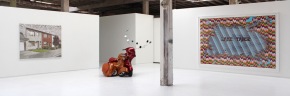
a view of my new york gallery, with an installation of sculpture by artist gay outlaw:

gallery-3.jpg